

Over the last couple of years, AdBlue® has become increasingly popular in diesel engines. This is because of the UK Government’s goal to reduce the nation’s emission rate and reach “net zero”. You may already be using AdBlue® and wondering what AdBlue® is, why you put it in your vehicles and how it’s made. Oilfast UK has you covered.
So what is AdBlue®?
AdBlue® is a liquid solution of urea (a component of synthetic urine) and deionised water. It is completely colourless and non-toxic. It was introduced to neutralise Nitrous Oxide emissions from diesel engines in line with Government targets. AdBlue® is a simple, effective and efficient way to reduce the fuel emissions of your business vehicles.
AdBlue® produces a chemical reaction when injected into the exhaust system of a diesel engine which neutralises the harmful nitrous oxide emissions produced by diesel vehicles. Through this, AdBlue® can help reduce exhaust emissions and improve air quality.
What is AdBlue® made from?
Two primary ingredients make up the liquid. AdBlue® is a colourless liquid made from high-purity urea (32.5%) and deionised water (67.5%). The solution poses little risk to humans or the environment as it is primarily water-based.
AdBlue® is made from an essential component of selective catalytic reduction, as ammonia, the active ingredient in the liquid reacts with NOx to neutralise it before it enters the atmosphere. As a result, there is a significant reduction of NOx in the exhaust fumes from diesel engines.
Is AdBlue® made from pig urine?
There has been speculation about AdBlue®, its ingredients and what AdBlue is made from. It’s one of the most searched things if you type in AdBlue®. Though the chemical “urea” is present in pig’s urine, AdBlue itself is not made from pig’s urine. It is a synthetic solution that is highly purified.
What is the science behind AdBlue®?
AdBlue® is a colourless liquid made from high-purity urea (32.5%) and deionised water (67.5%). The solution is an essential component of selective catalytic reduction (SCR) technology, which is one of the most effective ways of reducing the nitrogen oxide levels in diesel engines’ exhaust fumes.
Nitrogen oxide (NOx) is one of the most harmful pollutants emitted by engines. It reacts with other gases in the atmosphere to form small particles and ozone, both of which can damage sensitive lung tissue in humans and animals.
When the diesel engine burns fuel, AdBlue® fluid is added to the selective catalytic reduction catalyst to convert the nitrogen oxide into a less harmful mixture of nitrogen and water vapour. The solution is stored in its tank (blue lid), separate from the diesel, before being added to outgoing exhaust gas by a dosing control system that supplies enough AdBlue to make up 2–6% of the total fuel consumption.
In the SCR catalytic converter, the urea present becomes ammonia when heated, reacting with the nitrogen oxide in the emissions to convert the pollutants into nitrogen, water, and a small amount of carbon dioxide —elements that are already natural to the air that we breathe.
What emission regulation does AdBlue follow?
The Euro 6 regulation is the newest European emission standard for cars, and light commercial vehicles, whereby diesel cars have a limit of emitting 0.08g/km of nitrogen oxide and petrol vehicles have a limit of 0.06g/km.
It’s essential to have working knowledge on the AdBlue as every time you burn any fuel, you will be outputting fumes, and therefore AdBlue will be used. All manufacturers producing vehicles in the EU/EEA must ensure that their vehicles are tested to meet these acceptable emission levels. The incredible efficiency of an SCR system alongside AdBlue is the preferred test method used.
What is the Euro 6 regulation?
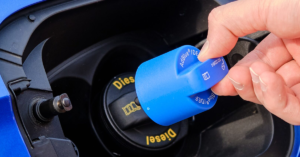
The Euro 6 regulation was first introduced in September 2014 and imposed on all new cars in September 2015. The only way most diesel cars of 1.6 litres and above will meet Euro 6 emission regulations is by using AdBlue. These days, diesel cars are built with an AdBlue® tank as it’s a legal requirement that all diesel emissions meet the Euro 6 limits. You may well have noticed the presence of a smaller blue or black cap adjacent to the main fuel cap — this is for AdBlue®.
Heavy-duty vehicles, like trucks and buses, have followed the Euro 6 regulation since December 2013. Although there are categories for different sizes, larger vehicles like buses and trucks are allowed a larger output of nitrogen oxide than cars and light commercial vehicles.
You can find out about the different categories here – https://www.rac.co.uk/drive/advice/emissions/euro-emissions-standards/.
Nationwide AdBlue® Suppliers
Oilfast UK works with national licenced AdBlue® distributors. This allows us to offer a nationwide supply of AdBlue in Scotland, England and Wales. Contact your AdBlue® specialists to discuss your fuelling options.